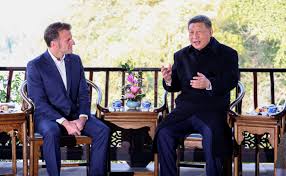
Chinese President Xi Jinping hosted French President Emmanuel Macron in the southwestern city of Chengdu on Friday, offering rare personal accompaniment on a sightseeing tour meant to underscore Beijing’s desire to deepen ties with Paris. But despite the warm gestures and carefully staged public diplomacy, Macron’s state visit has so far yielded few concrete economic or political breakthroughs.
Xi’s decision to personally welcome Macron outside Beijing—taking him to the UNESCO-listed Dujiangyan irrigation system in Sichuan province—highlights China’s strategy of engaging France as a key gateway in its broader relationship with the European Union. Notably, even during former U.S. President Donald Trump’s landmark 2017 visit, Xi limited all activities to the capital.
However, analysts say the cordiality between the two leaders has produced more symbolism than substance. While world leaders increasingly turn to Beijing seeking economic assurances amid shifting global trade dynamics and new U.S. tariffs under President Trump’s renewed administration, Macron’s visit appears largely focused on diplomatic optics and political image-building at home following a difficult summer in French domestic politics.
Few Commercial Gains Despite High Expectations
Investors had been watching closely for major agreements as Macron arrived in China accompanied by leading French business executives. Instead, a Thursday meeting in Beijing produced only 12 cooperation agreements, covering areas such as nuclear energy, population ageing, and panda conservation. No financial details were disclosed, fueling skepticism about the visit’s practical outcomes.
Analysts say France likely hoped Xi would offer more significant concessions, especially as the EU prepares to roll out new economic security measures.
“Macron probably felt that given his weight, and the fact that France is pushing hardest on economic security, he would get a deal— but nope,” said Alicia Garcia-Herrero, senior fellow at Bruegel.
Earlier in the day, the French president made headlines after surprising joggers during an early-morning run at Chengdu’s Jincheng Lake Park, followed by a joint appearance with Xi at the historic dam site. Later, he received an enthusiastic welcome at Sichuan University, where students crowded around him before his address.
In his speech, Macron urged China to reflect on its global responsibilities amid rising geopolitical tensions.
“We are at a moment of unprecedented rupture,” he said. “The world built after World War II—based on cooperation between powers— is fracturing.”
He also rejected China’s narrative that Western influence is declining.
“Plenty of people will try to tell you that Europe is old, or that G7 countries are arrogant,” he said. “But all of that is a narrative, a fabrication.”
Even as China signals interest in France as an EU entry point, Beijing faces tight constraints in offering major concessions.
Xi is unlikely to approve a long-anticipated 500-aircraft Airbus order, as doing so would weaken China’s leverage in ongoing negotiations with the United States, which has been pushing for more Boeing purchases.
Similarly, easing restrictions on French pork or cognac would compromise China’s bargaining position with Brussels over tariffs on Chinese-made electric vehicles (EVs).
Macron also cannot expect progress on Ukraine, as China has recently reaffirmed its political alignment with Russia.
Recent visits by Spain’s King Felipe VI and Germany’s Finance Minister Lars Klingbeil also yielded minimal outcomes, reflecting Beijing’s cautious approach.
Chinese advisers say China believes it now holds the stronger hand, expecting the EU to eventually accept its proposed minimum price plan for EVs instead of the tariffs currently in place.
European divisions are adding another layer of complexity. France voted in favor of the EU’s EV tariffs, while Germany—the bloc’s biggest economy—opposed them. China has already begun appealing to individual member states, raising topics such as a potential trade agreement, even though Brussels insists it has no plans to negotiate any such deal.
“It is interesting that they raise it with member states,” a European Commission official said anonymously. “We have no plans whatsoever to negotiate a trade agreement with China.”
As Macron concludes his fourth state visit to China, analysts note that the trip has strengthened diplomatic optics and people-to-people engagement—but delivered little in terms of the major economic or geopolitical advances France may have hoped for.