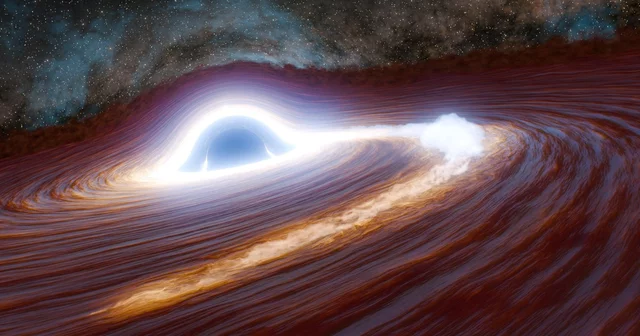
Scientists have observed the brightest flare ever recorded from a supermassive black hole, a cosmic explosion so powerful it shone with the light of 10 trillion suns.
The extraordinary event — a rare burst of energy from the depths of space — is offering new insight into how black holes behave and interact with their surrounding galaxies.
A Cosmic Beacon from 10 Billion Light-Years Away
The flare originated from a supermassive black hole located nearly 10 billion light-years away, making it not only the brightest but also one of the most distant flares ever seen.
Because light takes time to travel, scientists are observing an event that occurred when the universe was still young — less than a third of its current age.
(A single light-year equals nearly 6 trillion miles.)
The spectacular display was first captured in 2018 by a camera at the Palomar Observatory in California. Researchers say the black hole’s brilliance peaked over a three-month period before gradually fading over the following years.
A Star Torn Apart
Experts believe the flare was caused when a massive star drifted too close to the black hole’s gravitational pull and was ripped apart — a phenomenon known as a tidal disruption event.
“At first, we didn’t really believe the numbers about the energy,” said Matthew Graham, lead author of the study and a researcher at the California Institute of Technology, which operates the Palomar Observatory.
The findings were published Tuesday in the journal Nature Astronomy.
Why It Matters
Nearly every large galaxy — including our own Milky Way — hosts a supermassive black hole at its center. These cosmic giants, often billions of times the mass of the sun, are surrounded by swirling disks of superheated gas and powerful magnetic fields.
Despite decades of study, scientists still don’t fully understand how these black holes formed or evolved over time. Events like this flare provide rare clues.
“This discovery helps us probe how supermassive black holes interacted with their environments in the early universe,” said Joseph Michail of the Harvard-Smithsonian Center for Astrophysics, who was not involved in the research. “Those early interactions shaped the cosmos we see today.”
The Bigger Picture
This record-breaking flare adds to a growing list of discoveries that are reshaping our understanding of black holes:
In March 2024, scientists identified the oldest known supermassive black hole, formed when the universe was only 430 million years old — about 13.4 billion years ago.
In 2023, NASA researchers found another ancient black hole dating back 13.2 billion years, roughly 40 million years older than the 2024 discovery. It is estimated to be 10 times larger than the Milky Way’s central black hole.
Closer to home, the nearest known supermassive black hole lies about 1,600 light-years from Earth — roughly 10 times the mass of our sun.
Researchers say that continued observation of such flares can help unravel one of astronomy’s greatest mysteries — how black holes grow, merge, and influence the galaxies around them.
“Every new discovery like this pushes the boundaries of what we know about the universe,” Graham said. “It’s a reminder of how dynamic, violent, and beautiful the cosmos truly is.”