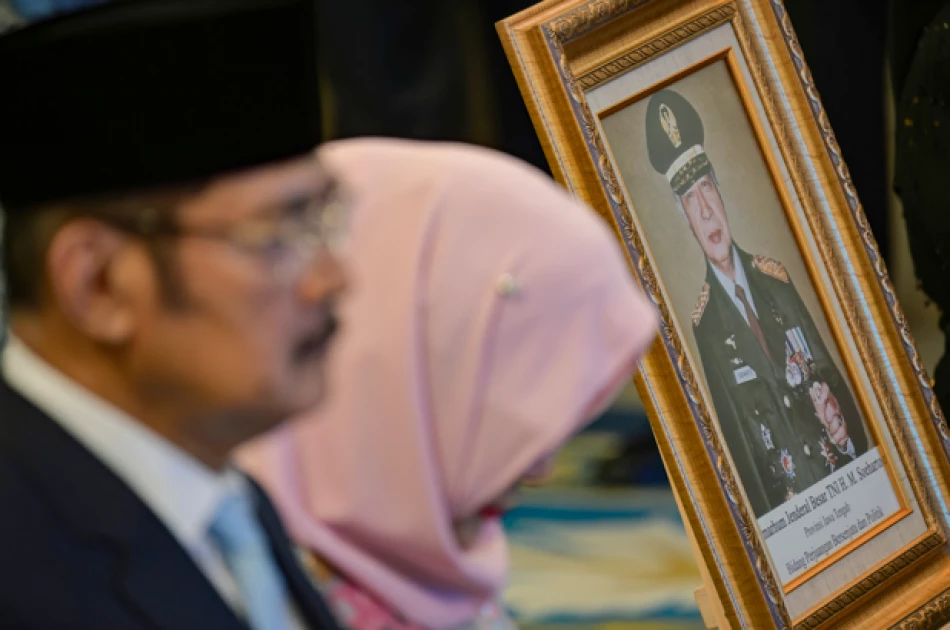
Indonesia has formally designated former president Suharto as a national hero during a ceremony on National Heroes Day, despite widespread opposition from activists and academics who argue that his human rights record disqualifies him from such an honor.
Suharto, who ruled Indonesia with an iron fist for over three decades, was named among 10 new national heroes by President Prabowo Subianto, the former dictator’s son-in-law, on Monday, November 10, 2025.
The decree, which officially recognizes Suharto’s contributions to the nation, was read by the presidential military secretary at the State Palace in Jakarta.
This new honor adds Suharto’s name to a prestigious list of over 200 figures, including independence activists, prominent women’s rights advocates, and Islamic scholars, as well as Indonesia’s first democratically elected president, Sukarno.
However, the move has sparked significant backlash from various sectors of Indonesian society. Suharto’s rule, which began in 1967 after he seized power following a failed coup, is widely remembered for its authoritarian nature, marked by widespread corruption, political repression, and brutal crackdowns on dissent.
His regime was responsible for numerous human rights violations, including the deaths of thousands of political opponents.
A petition signed by over 500 civil society members, activists, and academics was sent to President Prabowo last week, urging him to reconsider the decision to bestow Suharto with the national hero title. The petition condemned the recognition as a betrayal of the victims of his regime and a distortion of Indonesia’s democratic values.
“Suharto, as someone suspected of being involved in human rights violations, state violence, and various offences related to human rights abuses, does not deserve to be awarded the title of national hero,” said Dimas Bagus Arya, coordinator of the Commission for the Disappeared and Victims of Violence (Kontras), a local rights group.
Despite the opposition, Prabowo’s office stood firm on the decision, stating that he had the constitutional right to bestow the title of national hero on anyone he deemed worthy. “It is part of how we honor our predecessors, especially our leaders who have undoubtedly made extraordinary contributions to the nation and the country,” said State Secretary Prasetyo Hadi in defense of the decision.
Suharto’s children, Siti Hardiyanti Rukmana and Bambang Trihatmodjo, attended the National Heroes Day ceremony in Jakarta to honor their father’s legacy. Speaking to reporters after the event, Siti Hardiyanti Rukmana urged the public to remember her father’s long service to Indonesia. “Please remember what my father had done, from when he was young, until he was old, all his fights for this country and the Indonesian people,” she said.
Suharto’s leadership was marked by significant economic growth, but it also left a legacy of political repression, widespread corruption, and gross human rights violations. Under his rule, Indonesia experienced violent suppression of dissent, with tens of thousands killed or disappeared, particularly during the anti-communist purges of the 1960s. Suharto remained in power until his resignation in 1998, following a period of political and economic turmoil.
Despite his controversial reign, Suharto remains a deeply polarizing figure in Indonesia. While some credit him with transforming the country’s economy and guiding it through a period of stability, others remember him for his repressive policies and the human cost of his leadership.
Alongside Suharto, nine other individuals were also named national heroes during the ceremony. These include former president Abdurrahman Wahid, who passed away in 2009, and Marsinah, a slain labor activist who became a symbol of the fight for workers’ rights in Indonesia.
The inclusion of Suharto in this group of national heroes underscores the continuing debate in Indonesia over how the country should reckon with its past, particularly its authoritarian history. While some see Suharto’s contributions to national development as deserving of recognition, others view his legacy as a reminder of the costs of authoritarian rule.