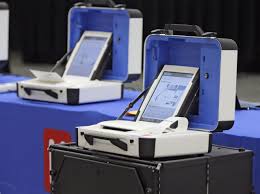
A group of Tanzanian university students has developed a digital voting system designed to make elections more transparent, faster, and harder to manipulate.
The innovation, unveiled this week in Dar es Salaam, was created by students from the University of Dar es Salaam’s College of Information and Communication Technologies (CoICT).
The system aims to modernize the voting process by allowing citizens to cast their votes electronically while maintaining strict security and verification standards.
According to the project’s team leader, Neema Mushi, the system combines biometric identification, real-time data encryption, and blockchain technology to ensure that every vote cast is unique, traceable, and tamper-proof.
“Our goal is to help improve transparency and public trust in Tanzania’s elections,” Mushi said. “This system records votes digitally but also keeps a physical backup to guarantee accuracy during verification.”
The students say their system can be used for national elections, university student government polls, and corporate decision-making. It was tested in a mock election involving over 500 participants, achieving nearly 100 percent accuracy in tallying results.
The innovation comes at a time when Tanzania is preparing for local government elections in 2025, and public discussions about electoral transparency and efficiency are intensifying.
Experts from the Tanzania Commission for Science and Technology (COSTECH) have praised the project as an example of how local innovation can solve national challenges.
“This digital voting platform shows how technology can strengthen democracy,” said Dr. Joseph Mwinuka, a digital governance expert at COSTECH. “It’s encouraging to see young people leading the way in developing homegrown solutions.”
The team plans to present the project to the National Electoral Commission (NEC) and hopes it can be integrated into Tanzania’s broader digital transformation agenda under President Samia Suluhu Hassan.
If adopted, the system could reduce voting time, improve results management, and help prevent errors and disputes that often arise during manual counting.
“We believe this is a step toward a more transparent, inclusive, and efficient electoral process,” Mushi added.
The students are now seeking government and private sector support to scale up the system and conduct larger pilot tests before the 2026 general elections.