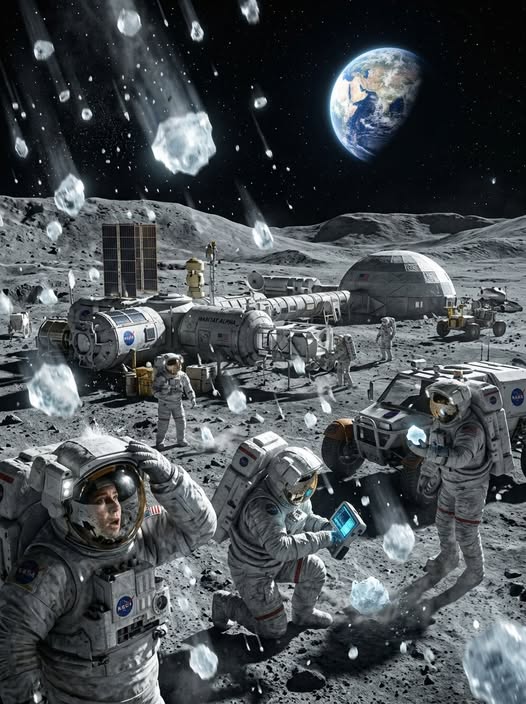
Scientists at NASA have been left stunned after reports of what appears to be a “hailstorm-like” phenomenon on the Moon—an occurrence long believed to be impossible in the lunar environment.
The development emerged as researchers analyzed new data and observations, raising serious questions about previously understood conditions on Earth’s natural satellite. Traditionally, the Moon has been considered incapable of supporting weather systems due to its lack of atmosphere—making any form of precipitation, including hail, scientifically implausible.
However, recent findings have challenged this assumption. The unusual activity, described as resembling a hailstorm, has sparked intense debate among scientists, with many now working to determine whether the phenomenon is being misinterpreted or if it points to a previously unknown process.
Experts note that without an atmosphere, the Moon cannot sustain clouds, rain, or ice formation in the same way Earth does. This has led some researchers to suggest that the observed event could instead be caused by high-speed micrometeorite impacts, electrostatic dust movement, or interactions involving solar radiation.
Despite the uncertainty, the discovery has captured global attention and reignited interest in lunar science. Teams at NASA are continuing to analyze the data in detail, hoping to uncover the true nature of the phenomenon and what it could mean for future exploration.
If confirmed as something entirely new, the findings could reshape scientific understanding of the Moon and its environment—highlighting that even the most familiar celestial bodies may still hold unexpected mysteries.